Mardi Gras was three weeks ago, but I can still ask you to “Throw me somethin’, Mister,” as they say in the Big Easy.
This time one year ago, I was experiencing my first day in Ascoli Piceno, joining the people of the language school I was about to spend two weeks studying with, in a walkabout in Ascoli’s Carnevale.
In Ascoli, they don’t throw plastic trinkets–they toss “coriandoli”, paper confetti. But what I want you to throw me are your stories, true and well told.
That’s a writing technique called “borrowed interest” and I’m not ashamed to use it to fill the digital pages of this blog. I publish writing prompts, book reviews, and stories from my own life, but my favorite content is YOUR stories.
Here are the guidelines. Now throw me somethin’, Mr., Ms., whoever you are! Send your true life stories to sarah.white@firstpersonprod.com and I’ll consider them for publication here.
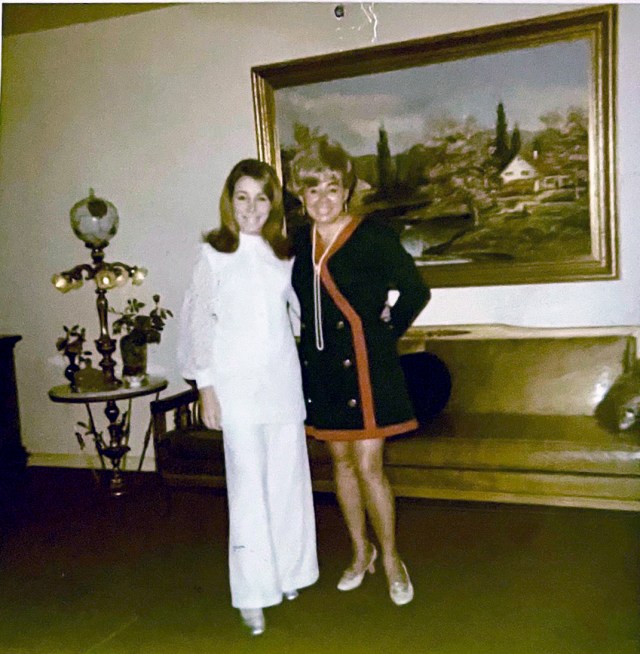
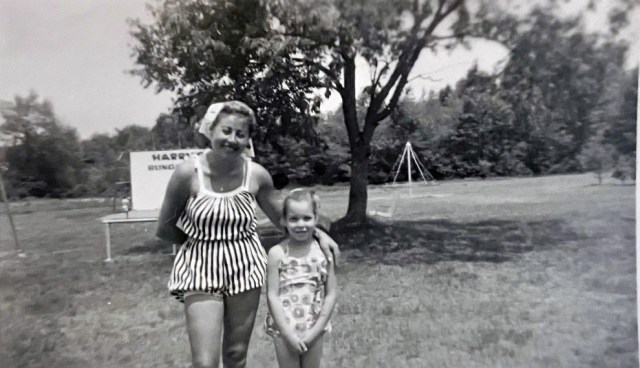
Brooklyn 1969, Sandra and her mother1957 Catskills, Sandra and her mother
The first time I became aware of having a heart as big as my mother’s was when we left Crown Heights for Canarsie. I was almost fourteen. Everything and everyone I said goodbye to seemed fragile in a way they hadn’t appeared before. As if my leaving weakened them. When we packed up the Crown Heights kitchen, I almost cried when my mother said she was throwing away our old silverware—two mismatched sets of stainless steel—as soon as we purchased two new sets. We needed one set for dairy and one set for meat, since we were kosher. I felt a special connection to our forks, which in Yiddish we called goopels.
If a fork was missing from my father’s place setting, he would ask me, Please bring me a fleishig goopel [a meat fork]. His words seemed to rise from the soles of his feet, as if the rugged Russian terrain he had fought on during the Holocaust had seeped inside him. His heavily accented voice came out thick and gravelly, spoke of the sadness of Jewish history, told of his family’s lives that were no more.
Sometimes I accidentally messed up the silverware. I ate a cheese blintz with a meat fork. If we had lived in the country, I would have run out the door, covered the fork with soil to make it kosher, as was the law. But since we lived in the city, as soon as I realized my mistake, I struck a match and put it to the gas burner, watched the flame rise. Then I held the goopel inside the fire, burned off the dairy particles.
I followed the Jewish laws my parents selected. Although once a week, my mother and I went out for chicken chow mein against my father’s knowledge. As we scurried down Utica Avenue to the darkened restaurant, she told me, “It’s our secret.”
We sat at a small table like spies and ordered wonton soup from Column A and an egg roll from Column B. We shared the one bowl of soup which we slid back and forth between us. All the while, my mother told me things about my father. She said he was cheap, his sisters were mean, he didn’t give her enough money for the house. That was why we shared the soup.
I ate two or three spoonfuls, leaving the strips of pork which my mother loved. I told her I was full, said she should finish. That’s what my mother had done in her shtetl in Czechoslovakia. She saved her food for the others.
When my mother and I strolled the promenade of Eastern Parkway, we memorized the walkway’s terrain. Trees sprang from the edges of the sidewalks; in spring, branches arced over us, blossomed with color, so that pink petals carpeted our path.
My mother. Goopels. Eastern Parkway. Everything I loved was alive with feelings and needs. When we threw away the goopels, I imagined them rising out of the garbage can, flexing and dancing in the air. The friends I left behind in Crown Heights waved a sad goodbye, and I promised I would return, see you soon. But my words were stiff, due to my self-consciousness of expressing love for anything outside my family.
My heart was big, maybe bigger than my mother’s. But she could never know.
Sandra Hurtes is a writer and teacher living in New York. Her work has appeared in The New York Times, The Washington Post, Poets & Writers, Women in Judaism, and numerous other publications.
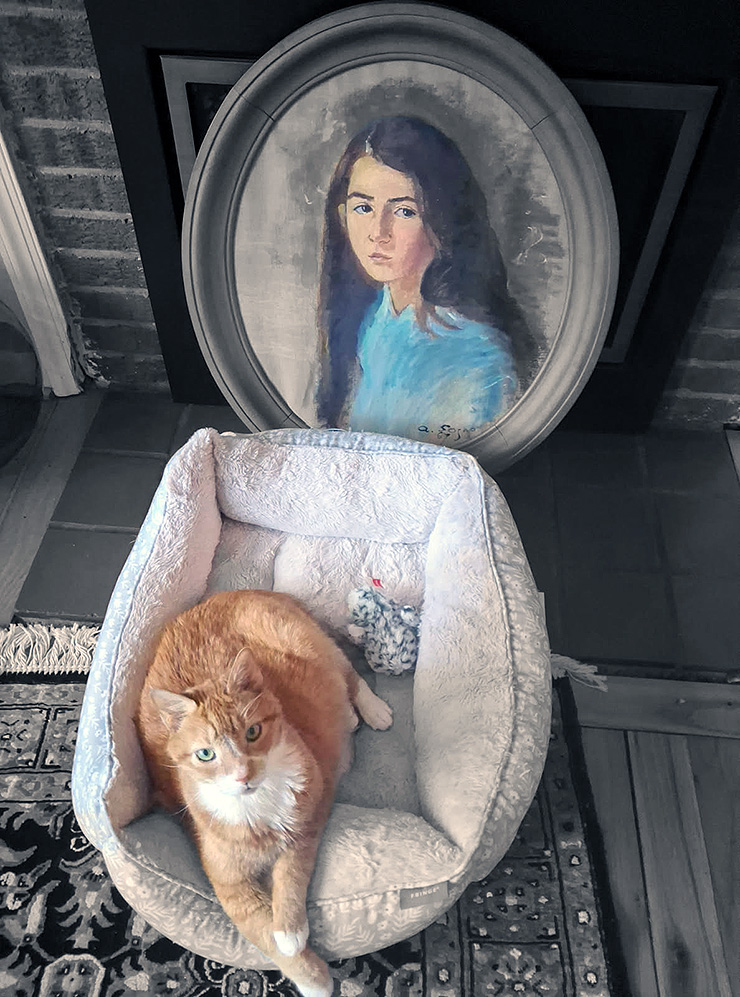
He’s an orange tabby, a big-bellied, easy-goin’ good ol’ boy from Wilmington, North Carolina, 16 when we bring him back to our home in Arlington, Virginia, after the sudden death of my sister, his owner—wait, “pet parent,” the preferred term among animal lovers—though Goober at 16 is 80 in human years and therefore older than his parent, who died alone in her apartment, her body found four days later, Goober by her side. Turns out the good ol’ boy belly is a tumor and Goober might die at any moment, says the vet, who wants to put him down. I’m a dog person, not a cat person (I know, I know, in the eyes of cat people, that makes me a control freak, even a closet misogynist, cats being independent, inscrutable, and, regardless of gender, feminine), but I love my sister and decide to do what she would have wanted me to do—let Goober live out what’s left of his life, until there’s pain—and that evening we take him outside in the last light of a late summer day to see and smell and hear what he, an indoor cat, has never seen or smelled or heard before. He sits up in my lap, suddenly alert, twitching his tail and jerking his head back and forth and up and down, trying to keep up with it all: cardinals and crows jockeying for position at the bird feeder, squirrels leaping from tree to tree, our resident rabbit nibbling the woodland phlox, a lone flickering firefly, a breeze rustling the leaves, carrying scents no human nose can ever know. He looks up at me in disbelief. It’s something, isn’t it Goober? I say. Overwhelmed, he curls himself into a ball in my lap and falls asleep, dreaming of his strange new world that has such creatures in it. My wife looks at us and smiles. “I guess he doesn’t know you’re not a cat person,” she says.
PS On Saturday evening, January 31, 2026, a year and a half after we brought Goober home, he passed away peacefully, lying between us on his favorite spot on the couch.
In addition to True Stories Well Told, Donald A. Ranard’s writing has appeared in The Atlantic, New World Writing Quarterly, The Los Angeles Review, Vestal Review, The Washington Post, The Best Travel Writing, and many other publications. In 2022, his prize-winning play ELBOW APPLE CARPET SADDLE BUBBLE placed second in Savage Wonder’s annual playwriting contest. Before settling in Arlington, VA, he lived and worked in Asia, Europe, and Latin America.
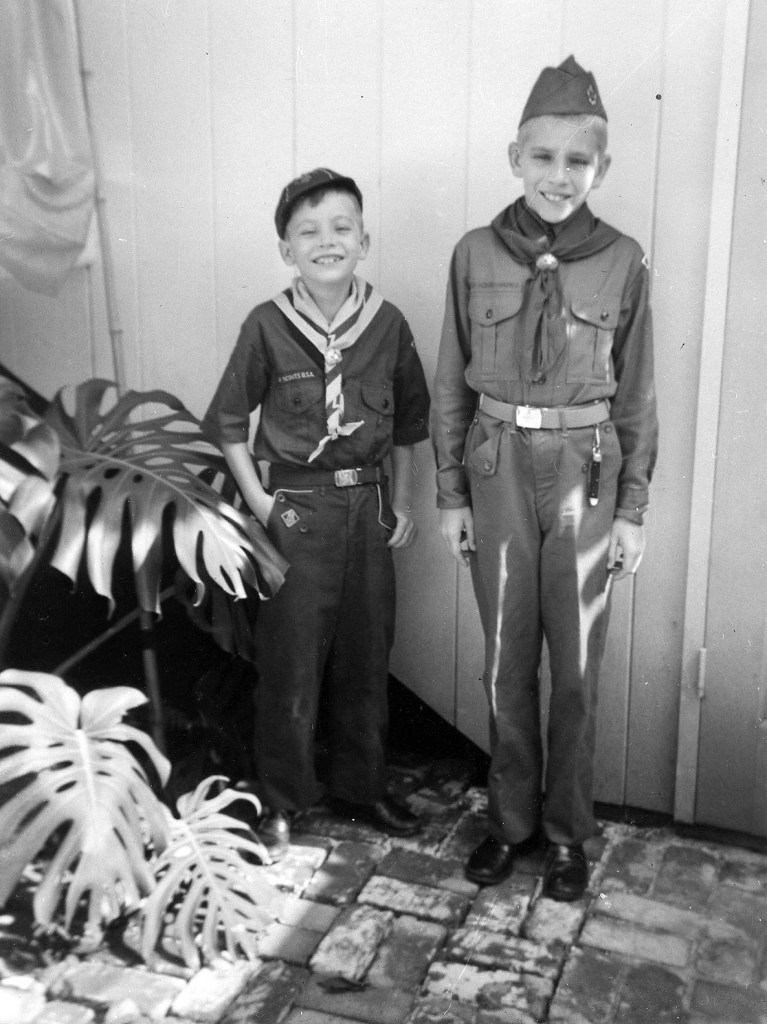
In full uniform, proudly posing with my cheerful Cub Scout younger brother. Honolulu, 1958.
Our nation’s self-proclaimed “War Secretary,” Pete Hegseth has spotted the enemy, and the peril we face comes from—the Boy Scouts! A recently leaked Pentagon memo reveals Hegseth’s intention to cut off decades-old support for what is now known as Scouting America.
Language in the memo—not yet official policy—criticizes Scouting for having become “genderless,” and echoes Hegseth’s earlier attacks on diversity, equity and inclusion. The proposal calls for the Pentagon to quit providing support to the National Jamboree, a gathering of thousands of Scouts held every four years. It proposes a ban on any Scout meetings at military installations. (But apparently Congress requires the Pentagon to support the Jamboree.) Preparations are currently underway for the 10-day event in summer 2026 hosting as many as 20,000 Scouts.
Hegseth’s proposals to dismantle the military/scouting relationship have already been widely criticized—and they run counter to one of my earliest impressions of Scouting.
I grew up in Honolulu, Hawaii, joining Cub Scouts and then moving on to the local Boy Scout troop at about age 11. Not long after that, there was a large gathering to provide Island scouts with an event similar to the National Jamboree. This was the Makahiki, a name chosen to echo a traditional Hawaiian festival. In the pre-contact Hawaiian kingdom, Makahiki marked the beginning of a new year, and was a time of celebration and rejuvenation. Warfare was prohibited, allowing for peace and tranquility.
The one Makahiki I attended was held at a site not commonly used by Scouts—the iconic (and extinct) volcanic crater, popularly known as Diamond Head, on the eastern edge of Waikiki Beach. Early in the 20th century, the crater became a key part of the U.S. Army’s coastal defense system, replete with bunkers, artillery batteries, tunnels and a command center.
At the event in the 1950s, we must have numbered easily 500 or more boys, spending a weekend camping in tents and doing what Scouts do—crafts, games, and various skill-building challenges. It was a big logistical effort, supported by the U.S. Army—trucks, equipment, chow lines, and a medical station. All highly impressive, compared to our small weekly troop meetings.
On arrival, we were instructed to take off our shirts, get in a very long line, and undergo a cursory physical exam. This procedure was unexpected, and I was mildly uncomfortable. Suddenly, I felt alone (where were my troop mates?) There I was, a skinny, self-conscious white boy amid a sea of diversity.
The exam would be brief—Army doctors with stethoscopes would listen to heart and lungs, ask a question or two, then move us along. Still, I remember my discomfort as the line inched forward.
One Army officer, likely a doctor himself, was standing to the side monitoring the line as we approached. I’m not sure what caused him to notice me—perhaps he sensed my unease. But as I got closer he spoke to me quietly, directly: “You’ve got good stomach muscles, son.”
Huh? Me? I’m sure I mustered a weak smile and a thank you. Then it was on to the stethoscope and the following three days of activities, of which I remember little. What has always stood out is that a competent and kind professional took an interest and informed me that, hey, I actually had well-toned abdominal muscles!
I went ahead with the activities—building rope bridges, stumbling along in a three-legged race, or hustling to build a fire and boil water—with just a bit more confidence than I might have had previously. It was a small gesture from that Army doctor, but it had an outsized and lasting impact on me.
That experience, and Scouting in general, has helped guide me through a lifetime of physical fitness, preparedness, and values endemic to Scouting. One of those values, which in those early years we seemed to absorb almost unconsciously, was acceptance of diversity.
My Scout troop, like so much else in the Islands, comprised a wide range of races and ethnicities. We were pals in the neighborhood, schools, and Scouting—Japanese, Chinese, Hawaiian, Portuguese, Caucasian (known locally as haole), and plenty of racial mixtures. It was simply how life was during my early years in Honolulu.
More recently, Scouting America has expanded female participation. Currently, nearly 1,000 young women have earned the Eagle Scout rank, Scouting’s highest achievement. Welcoming girls is part of a broad, multi-year effort toward greater inclusivity, with the organization now accepting LGBTQ+ members and recruiting families from all backgrounds and ethnicities.
Military support for scouting—an association that goes back more than 100 years—has obvious benefits for the armed services. It’s an opportunity for future recruitment, getting the attention of patriotic, civic-minded youngsters.
But Scouts take different paths. I went on to become a civil rights activist, anti-war protester, and, eventually, a Quaker. Regardless of any particular direction, I’ve seen the impact Scouting has made in the lives of my peers and others around me.
And while I now decry the vast U.S. military budget—approaching $1 trillion per year—I think back to what seems a more worthwhile spending priority—logistical support for Scouting activities. How about just a tiny sliver of that budget to encourage future leaders?
Secretary Hegseth sees Scouting America as not representing the “warrior culture” he seeks to promote. But consider the Scout Oath, conceived in 1908, in which a Scout promises to “…help other people at all times; keep myself physically strong, mentally alert, and morally straight.” In a perilous world, that seems like timely guidance not just for young Scouts, but all the way up the chain of command.
Writers gathered Monday night as usual for the monthly meet-up for reminiscence writers I host, First Monday, First Person. Rich shared this ripped-from-the-headlines poem, a cri de coeur for our country and the brave people of Minneapolis. Anyone alive in the U.S. in the 1960s will recognize how “history doesn’t repeat itself, but it rhymes.”
By Richard Senn
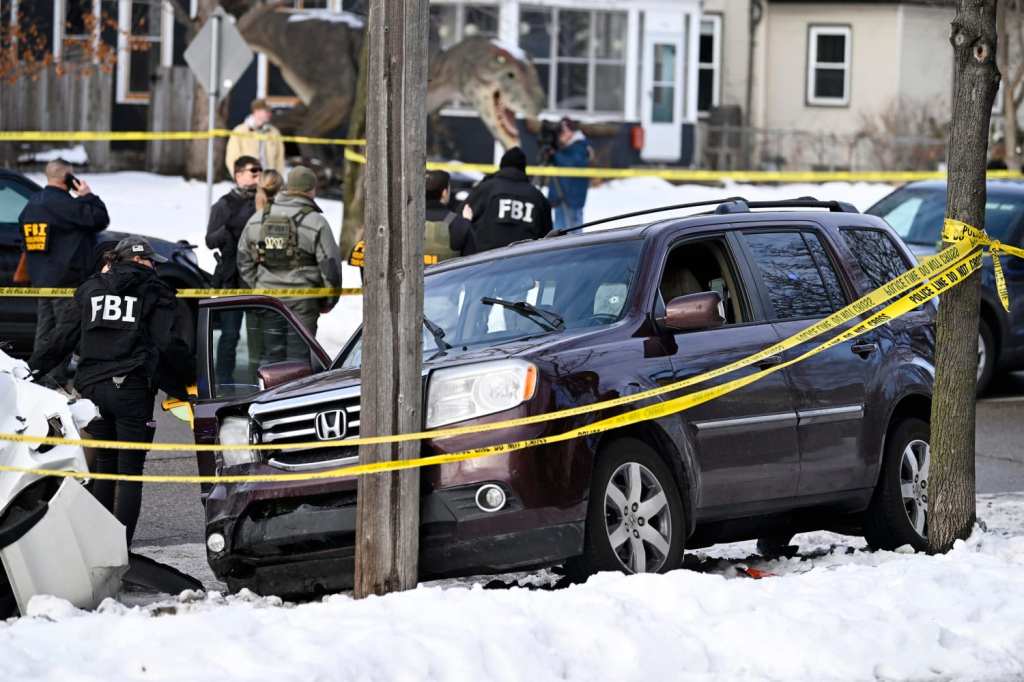
Young students march near Kenny Community School in Minneapolis, on Thursday, Jan. 8, 2026, a day after an ICE agent shot and killed a 37-year-old woman. Kerem Yucel/MPRProtesters gather outside the Bishop Henry Whipple Federal Building, Thursday, Jan. 8, 2026, in Minneapolis, Minn. (AP Photo/Tom Baker)Members of law enforcement work the scene Wednesday in Minneapolis.Stephen Maturen / Getty Images
Rich is retired from working for over 25 years in the biotechnology industry. He started spending more time on his writing this year with a particular emphasis on creative nonfiction.
“My Islands” originally appeared in Wisconsin Writers Association Creative Wisconsin magazine, October 2025.
I’m in love with islands. Their siren call streams through me like those neutrinos constantly passing through all of us. Thinking of an island of any type makes me happy, and when I’m on one I find special freedom in its circumscribed space. On an island our limit is proved, death certain, and so there is no escaping the knowledge that every one of our actions is consequential.
The first island I landed on was Monhegan, off the coast of Maine. One square mile, no cars, no paved roads, reached only by ferry. I was eight. My sister and I spent the first day on the wild eastern side, Atlantic breakers crashing over us and pinning us to black rocks. That night over dinner in the lodge we were chastised by the owner. It impressed me that he spoke to us, not my parents. He’d seen us playing on the rocks, dodging waves and hanging on through the streaming foam when hit. Perhaps it was made up to terrify us but he claimed that the week before two kids had been swept from those rocks and out to sea.
Islands that followed are Ibiza, San Juan (in Washington), St. Lucia, Barbados, Big Pine Key, the big island of Hawaii, Ko Samet, Sicily, and Lesbos, which is so large it contains two mountain ranges. Sappho and her exquisite sensibility came from there. Aristotle, the observer of phainomena, exiled himself there to do biology experiments in the skinny lagoon that makes Lesbos look like an amoeba undergoing mitosis.
Its now ten years since the great migrant crisis of 2015. My partner Susana and I were on Lesbos that October when ten thousand people every week landed on the north coast after crossing in small boats from Turkey. We were aware of the refugee crises but didn’t know that Lesbos was a prime destination until we arrived and found the shuttle from the airport crammed with reporters and camerapeople. Driving to our lodging near Molyvos on the north coast we passed hundreds of refugees walking toward the capital Mytilene.
We were tourists. Our first full day on the island we visited a small building covering pools fed by hot springs. The women who owned the building instructed us to first immerse ourselves in the near-scalding water for two minutes then race outside to stand in the cold sea before returning for another immersion. Susana couldn’t force herself into the hot water and instead relaxed on a bathchair in the humid air. Counting off the seconds while trying to not panic I finally stood up and ran outside to cool off in the sea.
And there I am, hip deep in the Aegean, fingers swirling the water, staring into the distance, oblivious, relaxed, and psyching myself up to go back inside for the painful-then-pleasurable-then-panicked spell in the hottest water I’ve ever been in when, bouncing over the waves toward me, there appeared a dingy full of people. There must have been forty adults in a craft built to hold twenty. I ran inside to dress and then back outside to meet people clambering up the rocky shore to the dirt road where I stood.
A jeep with aid workers zoomed up behind me, the woman driving yelling at me in French. I understood by her gestures that she wanted me to urge the people to come to the jeep. “Qu’est-ce que c’est?” I blurted out, a melodious phrase remembered from French films. Or possibly I said “Quelle heure est-il?” because that too rolls off the tongue. Whatever nonsense came out of my mouth, my astonished point was, “Aren’t you the aid workers?” But the woman got out and shooed me toward the new arrivals, again telling me to get them to come to her.
I had only English to use. “Excuse me, that lady over there might be able to help you.” One of the travelers who spoke some English explained that they had no intention of talking with aid workers. Next to me another man unwrapped what he’d used to waterproof his phone and made a call. I was told that the boat his brother and family were on was still out there in the waves, and this first group was going to wait to see if that boat made it across. I went back to report this to the French in the jeep and received scowls. They zoomed off. To do what I have no idea, as they seemed reluctant to engage directly with the cold, wet people who had just arrived.
The travelers’ greatest fear was to be separated forever from family members still trying to make it over the sea. Once they got on one of the many tour buses pressed into driving people to the camp near the capital, there was no telling what would happen to them. Most chose instead to walk over the island’s mountains to reach the harbor at Mytilene, hoping to avoid the camp and somehow find a way to continue on to the mainland and then central or northern Europe. They chose to stay together and govern themselves rather than turn their lives over to the well-intentioned but chaotic (and sometimes literally imprisoning) aid process. Many of the people who made the crossing remain trapped in the giant migrant camp. Today a second camp is being built.
To be on vacation and to find myself unexpectedly among heartbreak and chaos and suffering was to also witness a tenuous hope as expressed by the majority of Greeks, who though struggling themselves, were sacrificing to help strangers. A common sight in the little shops along the coast was locals mingling with aid workers and tourists, speaking many languages, all of us buying up whatever we could carry down to the thousands of people arriving every day. One shop owner near the hot springs simply said “take, take” when we came back and no longer charged for the items. At one point, I stood side by side with a local watching the latest group to set off over the mountains on the walk to Mytilene. As if he needed to explain why he provided help, he said in accented English, “Some people know what time it is, some remain asleep.”
The women who ran the hot springs had a method of helping that was heartbreaking and beautiful in its practicality. When a boat landed they coaxed people with children to come to their building. Of that first group I saw land, the women managed to direct a few women and several children to their building. All were soaking wet. The Greek women stripped the shivering children of their wet clothes, threw these in a pile to be washed and dried and then, because the families had to keep moving, dressed the children in the clean, dry clothes of previous arrivals.
Susana helped strip, dry, and dress two little Iraqi girls. Then, wearing the clothes of Afghani girls who landed on Lesbos the day before, these girls continued with their family on their frightening journey of hope—to find a safe, welcoming country in which to start a new life. Soon their clothes would wind up on children from another country.
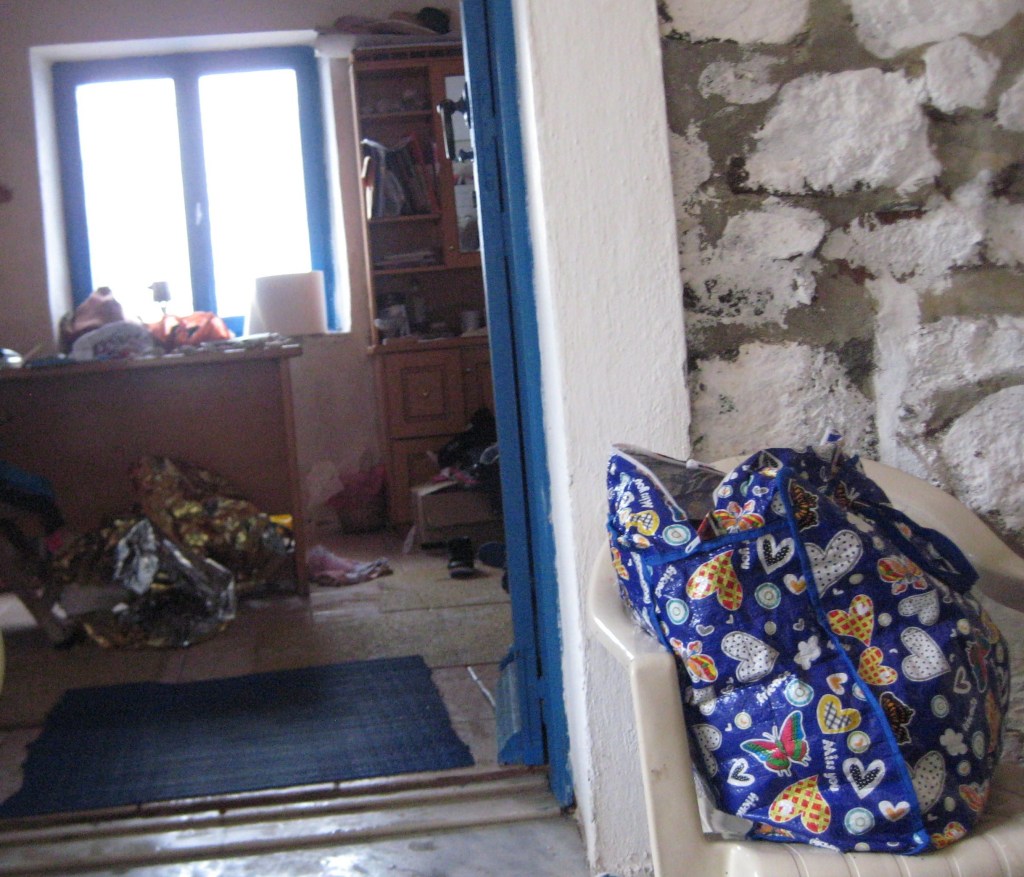
As they were being dried and dressed, I sat next to the large colorful bag covered with a multitude of hearts the girls carried on their journey. Their only belongings. Imagine what’s inside: the well-worn, the well-loved, the things they judged most valuable moments before they left their home forever.
After landing back in the U.S. and entering our comfortable house we saw a news story from that same coast. One of the dinghies sank and babies, children, fathers and mothers died. That year 100,000 people made that crossing. I feel helpless to hope for happy endings for all those desperate people. Yet sometimes late at night, in my yellow armchair by a window where the moon often peeks in, I find myself trying to picture where those Iraqi girls are now. Here on this yellow cozy island where imagination is free, I’m able to construct stories in my head of the girls happy, safe, and laughing.
This January in Chicago, where I feel fortunate to have settled, temperatures have given me a serious “deja vu” attack. Our arctic blast brought to mind a period in my life I’d all but forgotten!
Until my teens, I lived in Montreal, Quebec, Canada. Situated on the St. Lawrence Seaway. The city is renowned for its old-world ambiance, lip-smacking cuisine, and the quirk of French remaining the legal language in one of our closest geographic neighbors. Americans often remark that when they visit Montreal, they feel as though they’ve gone to Europe—France specifically—only much closer and without jet-lag. That’s great except Montreal is also notorious for shockingly brutal winters.
Throughout high school and my first two years of college, I’d saved all my pennies and all my dimes from summer jobs and weekend babysitting. Religiously, I’d walk to our neighborhood bank—savings account passbook proudly in hand—humming as I strolled. The song: lyrics of the 1962 Beach Boy’s song, “Little Deuce Coupe,” “I saved all my pennies and all my dimes…”
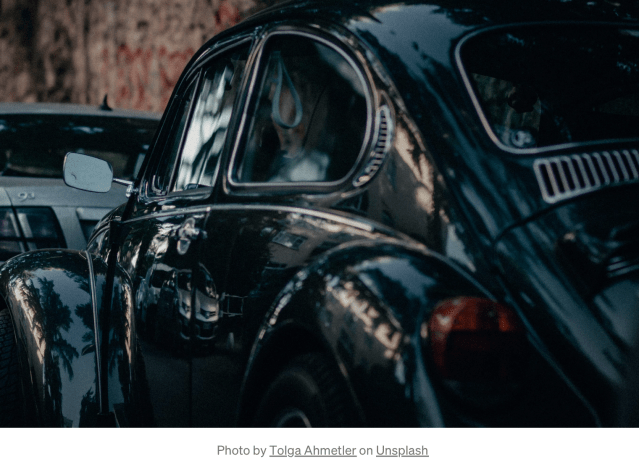
In 1970, the summer before I would enter junior year at university, the administration approved upper-class students having cars on campus. I was beyond ecstatic and intended to do just that. My small fortune, faithfully saved over the years, totaled an amazing $536. With Dad’s guidance, I found a road-worthy 1959 black Volkswagen Beetle for $500. The remaining $36 paid for floor mats and a pre-paid gas card. The car’s odometer read 160,000 miles. The number was of little concern to me since I’d read that due to the Volkswagen’s extreme simplicity of design, the road-bug was destined to run forever.
My black beetle was a four-speed stick-shift on the floor, cute and somewhat other-worldly looking on campus. It sported exterior running boards—a tad rusted and sagging in parts—plus shiny metal bumpers with their share of dents. None of these features soured my love of my first car. But the pure “simplicity of design,” I soon discovered, meant the 1959 VW lacked both a gas gauge and a fan that might deliver heat into the car during the frequently arctic Midwest winters. And seatbelts? Of course not. In retrospect, we didn’t pay attention to them. Given our youth, we perceived ourselves as indestructible, and besides, seatbelts weren’t standard equipment in cars until 1968. But we definitely knew about gas gauges and car heaters! Every car I’d ever been in had them.
My black Volkswagen Beetle was equipped with a “reserve tank.” The metal acorn-squash-sized globe under the steering wheel held precisely one and a half gallons of gas. Should my beloved bug begin to sputter — a sure sign I was running out of gas—I’d flip a lever on the acorn squash. Reserve gasoline would pour into the main tank, the VW shuddered and bucked like a rodeo bull for a few seconds, and then all would be good again, at least for a while. My math wasn’t the greatest but at approximately thirty-eight miles per gallon, the extra fuel gave me anywhere from fifty-four to seventy more miles, depending upon weather, traffic conditions, terrain, and how much coasting in neutral I managed in my search for a gas station before totally running out of gas and getting stranded.
The absence of a gas gauge was simply inconvenient compared with the vastly more serious, even life threatening one: the absence of a heater or fan. During Chicago’s arctic winters, that was the only way to generate heat in my 1959 Volkswagen Beetle. Increasing the motor’s RPM’s (revolutions per minute) by downshifting usually did it but only when the car was warmed up. The racket did make the engine sound ready to explode, however. The method forced hot air from the motor to blow through thin slits at the windshield’s base, the auto designer’s concept of vents.
The first winter I owned my beloved beetle, I quickly learned the importance of never driving anywhere alone unless absolutely unavoidable, and if I did, wrapping a scarf over my mouth and nose to minimize my exhaled breath that reached the windshield was essential. Why? Because condensation from breathing when reaching the windshield created an ice layer at an alarming rate.
The lifesaving task assigned to every passenger: remain as quiet as possible so as to reduce breath that condensed into yet more windshield ice—but also take responsibility for the ice-scraper. Passengers scraped the windshield’s interior ice as it formed—the task’s importance could not be underestimated— since accumulating ice obscured the road’s visibility.
Objectively, I probably overpaid for the car. But the freedom it provided remained unquantifiable. I’d bought myself independence plus the means to distance myself from home and parents at a point in life when such things could not be over-stated. After my first arctic Midwest winter with my 1959 beetle, my friends and I settled in to a comfortable “winter travel in the Marlene-wagon” routine. I was the envy of most of my friends, rarely lacking for passengers eager to assume the ice-scraper job. By the time I graduated university, the running-boards had rusted off and my metal bumpers, beyond dented, had been replaced with rubber strips cut from old tires.
This week, temperatures have hovered at below-zero double digits. Getting into my modern-day wonder vehicle and pulling out of my garage, my steering wheel heats up, my bottom feels warm as the seat-heater turns on, and my toes grow toasty. I exhale a deep sigh without the slightest concern about icy windshield consequences.
My little black beetle may have lacked heat, a gas gauge, seatbelts, and in all likelihood shock-absorbers, but always will retain a spot in my heart as the greatest car I ever owned.
Marlene holds a Ph.D., from University of Chicago. A research sociologist by training, she writes creative non-fiction by preference. Currently, she is completing her book entitled Ask Mr. Hitler: A Memoir Told In Short Story. She is coauthor of The Seamstress: A Memoir of Survival, and author of When Digital Isn’t Real: Fact-Finding Off-Line for Serious Writers. Her essays and stories have been published widely in anthologies, journals, and online. (www.marlenesamuels.com)
I’d like to think of myself as a kind, caring person—not sexist or racist or any -ist–but having a verbally racist parent and growing up in the 1950s and ‘60s in a small, rural town of only “white” folks, with Italian or French ancestry being considered “exotic”, I don’t have that luxury.
I do have at least one advantage helping me out of that–that of being an outlier in my family—and community? — from teen years on. So, like some of those folks in the book How Minds Change, I needed to go searching outward for my “tribe”. This survival trait of “tribe”, so deep some would prefer to physically die rather than be an outcast.
So, after graduating from high school, I went out exploring to different churches, friends of different ancestry, different cultures through college groups and books and work. Through working to listen to the “other”, I married someone of Puerto Rican ancestry—different enough from the white males that had harassed me, but “whiteish” enough for my family.
And the weeds in my mind started popping up. In my late 20s, my mother told me I was part Native American; later, someone noted that since my great-great-grandmother was female, I might also be part African. Whoa!! Oh, weed! Read some more, listen some more. Friends of Asian, Puerto Rican and African ancestry. Start trying to even the playing field here and there, continuing to weed out the garden of my mind and plant new loving seeds instead. Listen to Maya Angelou in college, read Langston Hughes, admire the artistry of Faith Ringold and the art of Asian, African and Native American. Read of the rich and vibrant African nations of the past.
As I read and listened, I began to understand the depth and breadth of sexism and racism in our country. I began to act, at least in small ways, to work at weeding the garden not just of myself, but of our society.
At the emergency child care, when the black child chose the blue-eyed, blond doll, I chose the darkest doll and said, “I think this one is pretty.” Just one thin thread. I contribute money and some energy to MOSES, for relieving the extra burden our current “justice” system places on black people. I attended gay concerts. I contributed some money to the Native American center in Milwaukee. I worked to be at least— or a little more— as polite to our brown or black citizens as I would be to any “white”, to counteract some of the mico-aggressions they receive daily.
So, what does all this have to do with three books?
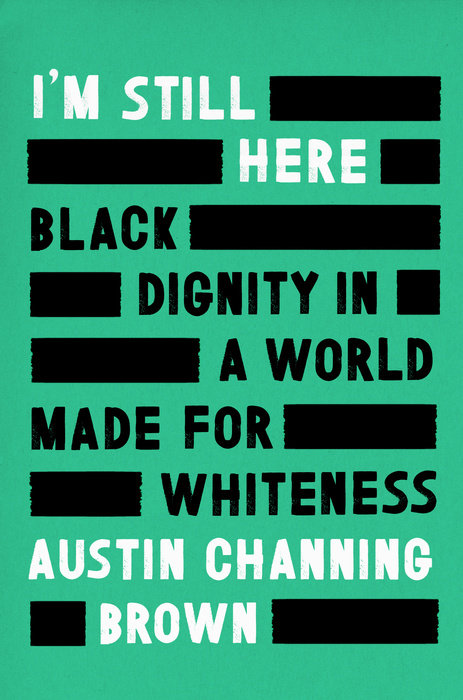
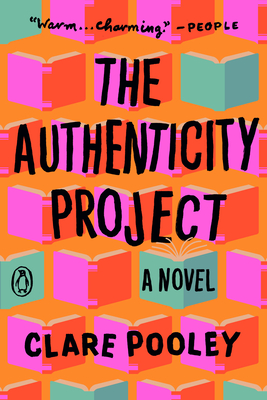
Recently, I got three books from the public library, two non-fiction on the “Good Books to Read” stand at Pinney Library, and the other, an earlier novel written by the author of a current bestseller. The novel was The Authenticity Project, by Claire Pooley, set in the UK. The two non-fictions were The Soul of a Woman by Isabel Allende and I’m Still Here: Black Dignity in a World Made for Whiteness by Austin Channing Brown.
Lonely and depressed, an aging artist starts an Authenticity Project, writing his truth in a journal and leaving behind both the journal and a challenge for others to write their truth. Various people pick up the journal, write their truth and, sometimes, as they read others’ entries and interact with each other, their truth changes.
As I read the truth in Isabel Allende’s and Austin Channing Brown’s books, my perspectives also changed somewhat. I realized how often I’ve settled for or appeased to “white male truth”. I realized more clearly just what the micro-aggressions blacks have complained about are, the emotional toll of these microaggressions, and how often they might happen, even in just one day. Words and gestures can hurt. When I dealt with these in my family, I sometimes wished I would just be hit, so I could show the physical bruise or broken bone. As a result of these books, I’m re-thinking of where and how I want to spend my time, energy and money.
Another novel I read talked about a character that was “nice” (read: polite), but not “kind” (read: caring) and another that was not nice, but was kind. How can I continue shifting and growing my life to be authentically true and kind and leave the world just a little kinder before my exit call? You?
Kay has been writing in various forms since a child, beginning in elementary school with creating and telling fantasy stories to a captive audience on the long ride of a rural school bus. She has had published a scattering of poems and articles and has given a few church talks. So far, though, the only money she has received was a dime from Bobby in the seventh grade for writing a story for him in English class. (I wasn’t pulled in later by the teacher; I don’t think he was, either.) Ten cents bought a lot of penny candy at the small neighborhood grocery store. However, for now, shared enjoyment or a new perspective is enough. Kay also enjoys hiking, biking, singing, reading (of course!), swimming (with friends), some social justice activities and the small adventures to be found in everyday life.
It was a celebration of someone’s life, and I dreaded going. What was the matter with me? Normally, although I don’t look forward to such occasions, I’m okay to go. But this was different. We weren’t close to Lana and Bob, her recently deceased husband; in fact, we had only met a few times. I knew they were involved in good works, and politically active, which I admired
But I didn’t know the last time I had encountered Lana, at a gathering of mutual friends, that Bob had developed rapid-onset dementia, Blithely unaware of Bob’s diagnosis, or that he had been admitted to memory care, I made a light-hearted remark about his absence, suggesting he had better things to do, ha ha. Lana replied, imforming me–somewhat tersely–of his whereabouts. I felt awful and embarrassed and started to nervously over-apologize, which of course made her tear up. Had there been a hole available, I would have unquestionably crawled in. Instead, Lana turned away to join a different conversation while I silently inhaled my order of fish tacos so quickly I barely noticed their limp coldness. Lana left shortly thereafter, and I sat dejectedly blaming myself and desperately uncomfortable, wishing I had known about Bill.
With that very discomfiting memory of our previous meeting front and center, I now faced having to express my regrets to an acquaintance I may or may not have insulted.
After two weeks of almost constant worry, I reminded myself that not everything was about me, and at the very least, I would be increasing the attendance for her husband’s memorial. It was the one thing I could do.
Normally, I would have had little angst over what outfit to choose, but the previous week, I had managed to trip on our bedframe in the middle of the night and break my little toe, And, may I add, for purposes of sympathy, it was quite painful. My sartorial quest was to find an outfit that would at least diminish the unfortunate mismatched footwear, one normal and one toeless Velcro strapped surgical shoe. I chose a midnight blue top and midnight blue patterned pants. Black socks hid my bare toes in the surgical boot and a black shoe on the other foot was the best I could do footwear-wise. A deep breath and I was ready to go. Except–
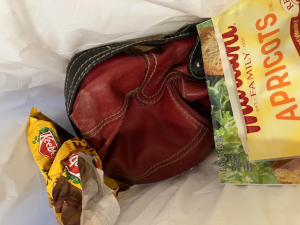
Just as we were about to leave for the event, I remembered a small shoulder bag I hadn’t used in several years, buried in my bottom dresser drawer. The purse was cherry red, easy to wear over my shoulder, with just room for my phone, wallet, and comb. Just that little pop of color I was always reading about in those “what to wear” fashion articles online, subtly enhancing my very somber outfit. It was a celebration, after all. I was delighted to have remembered it at the last moment, that little bright red dot of confidence. At least I looked as good as one could limping around in two wildly mismatched pieces of footwear,
As we arrived, I was still having reservations. Should I mention our conversation and apologize, or just not say anything? At least I would be there in friendship; Lana was free to think whatever she might. Whatever. I would just have to deal with myself. Remember, it’s Not. About. You.
I asked my husband to check my shirt for cat hair before we went in, and he did some serious brushing on the back of my shoulder.
“Just some fuzz, or something,” he reassured me.
I didn’t have any idea where I had encountered fuzz between our garage and this parking lot. But at least he had removed it before I went in.
“Just a minute.” He had stopped at the top of the stairs. “A little more fuzz.”
“Huh, is there a cottonwood around here?”
“Don’t know, but I think I got it all.”
We walked downstairs and I switched my purse to the opposite shoulder. A little tuft of fuzz wafted by. Then I noticed the strap had a wee bare patch at the top and the lining had rubbed off on my shirt. A brief pluck of my shoulder before stepping into the receiving line.
Lana saw us, gave us each a warm hug, and held my hand tightly.
“Oh, you came! I’m so glad to see you. Thank you, thank you for coming!”
I was so relieved it was my turn to get a little teary.
As we left the line, we ran into a couple of good friends.
“Faith!” said my blunt-spoken friend in her broad Australian accent, “@hat’ s going on with your purse? It’s shedding!”
“I know. I guess the strap is a little worn. I should have checked it out before I left.”
“It’s not just the strap.” She was laughing so hard her wine began to slosh over the edge of her glass.
“What?” I squeaked.
Now my husband and her spouse were starting to laugh, too.
I pulled the purse off my shoulder and examined it. Unbelievably, the entire covering had begun peeling off the liner, which was shredding exuberantly. White fuzz was everywhere, covering me and floating throughout the room, stealthily drifting onto other guests. At first, I was mortified, then suddenly the hilarity of the situation struck me, and I was laughing as hard as the rest.
“Let’s find a table,” my friend suggested. “You can hide it in the corner.”
Had I been wearing pants with pockets, I would have taken my phone and wallet out and thrown the damn thing away. It was kind of like wearing the Scarlet Letter. Hard to live down.
“Do you happen to have a trash bag with you?” I asked.
She did not. She just laughed. I parked my little desiccated accessory behind a floral arrangement, brushed my entire outfit off, with a little help from my friends, and proceeded to fill a plate with delicious snacks and enjoy the presentation.
Returning home, I showed the purse remnants to my son and amused him by dropping it emphatically into the trash,
So really, it wasn’t all about me, only it kind of was, too. I did the right thing for Lana, and I wasn’t arrested by the fashion police. Score two!
Faith has been writing to amuse her family since she was old enough to print letters to her grandparents. Now retired, she has taken the opportunity to sort through family memorabilia, discovering a wellspring of tales begging to be told, which she hopes to expand upon in written form (where appropriate, of course!). She and her husband live in Madison, Wisconsin. They are the parents of two great sons and a loving daughter-in-law, and recently expanded their family to include Thistle and Bramble, two irrepressible young felines.
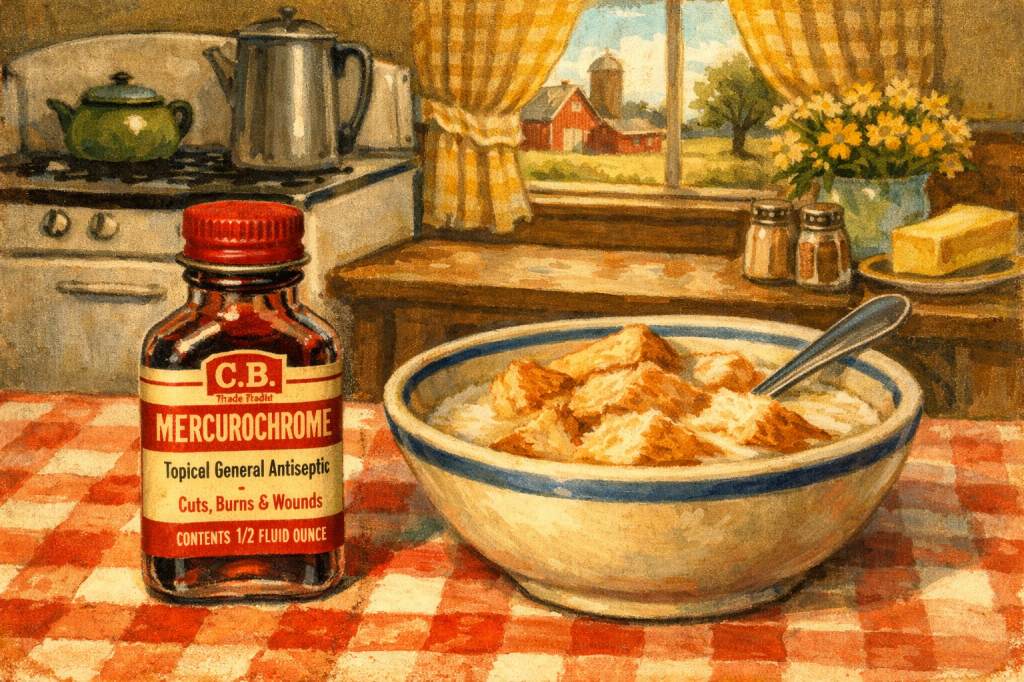
In our house when I was growing up, you didn’t go to the doctor unless you were A. bleeding to death or B. weren’t breathing. Anything else requiring medical attention was pretty much managed at home. I do vaguely remember one visit to our local clinic as a three-year-old after I climbed on the bottom open drawer of a clothes dresser. Mom had turned away from me for just a second, and the dresser crashed to the floor with me underneath. I was fine, but the tip of the pinky finger on my right hand wasn’t. It was missing, and there was blood everywhere, one of the criteria for a trip to the doctor, so off to the clinic we went, Mom driving, and Grandma holding me in her lap, putting pressure on the wound with one hand and holding the end of my finger in a clean dish towel with the other. Turns out the doctor couldn’t reattach it because the severed tip of the finger was so small. So, he tossed the fingertip in the trash, stitched up the wound, wrapped it in a gauze dressing that to my three-year-old self looked like the top of a vanilla ice cream cone, and sent us home. Had Mom known the finger couldn’t be reattached before we left for the clinic, she probably would have kept pressure on it, doused it in Mercurochrome, bandaged it up, and saved the hospital bill. My dad used to say the only place you could find sympathy in our house was in the dictionary. Anyway, I managed to survive my many childhood maladies and mishaps thanks to Mom, mercurochrome, and milk toast.
Children growing up in the 1960s were very familiar with Mercurochrome. This red, syrupy-looking liquid, used as an antiseptic for minor cuts and scrapes, was a standard item in home medicine cabinets. That is, until 1998, when it was banned by the FDA due to its high mercury content. But back then, if I came in the house with a scraped knee, small cut, or bleeding bug bite, out would come the familiar bottle, with its black rubber squeeze bulb jutting out of the screw cap. Mom would grab a washcloth, clean the wound, unscrew the cap, and squeeze the liquid liberally from the glass dropper on the affected area, admonishing me to “stop crying and hold still because it’s a long way from your heart!” Once applied to her satisfaction, she would blow on the wound in an effort to let the liquid dry before covering it with a band-aid. I guess the Mercurochrome was antiseptic enough to ward off any germs from her mouth. Looking back, I really didn’t mind the “red stuff” as we called it, or the orange-red stains it made on my skin. Nor do I remember ever getting an infection from a wound treated with Mercurochrome, so the stuff must have had some merit. But milk toast…That’s another story.
Milk toast was my nemesis. Milk toast was mom’s remedy for sore throats, indigestion, dehydration, and upset tummies. Alternatively, it served as a poultice to draw out stingers, the core of a boil, or pus from an infected wound. In Mom’s book, if Mercurochrome couldn’t fix it, milk toast would. To make this magic cure-all, Mom would toast a slice of white bread, cut it up into small cubes, and place it in a cereal bowl. Then milk, warmed on the stove in a small aluminum saucepan, was poured over the bread. A tablespoon of sugar—or sometimes two if she were feeling generous—would be stirred into the bread mixture and left to soak into the toast until it was a soggy, sloppy mess. Only then would she place it on the kitchen table with the words, “Honey girl, I made you some milk toast. It will make you feel better.” The stuff didn’t make me feel better. It was awful. It tasted like wet paper and paste. In fact, I think the paper and paste would have tasted better. But mom was so sure it was the cure, I had no choice but to hold my nose and suffer it down.
Occasionally, the toast was not for eating but for slapping on my skin as a poultice. The preparation method was the same, but instead of ingesting it, Mom would place the concoction on the affected area as soon as she could safely do so without burning me. Once the milk toast plaster was in place, she would wrap the area with plastic wrap, put a towel over it, and there I would sit, milk oozing out of the soggy toast and running down my leg while I impatiently waited for it to do its magic so I could get back outside.
Thankfully, with new science and a plethora of over-the-counter products available in any drug, grocery, or big box store, Mercurochrome and milk toast are largely forgotten except in the childhood memories of Baby Boomers. My grandchildren look at me in puzzlement when I mention Mercurochrome and in wide-eyed horror when I explain about how we would sometimes eat milk toast and other times slap it on our skin to draw out pus. But I remind them that I am still here, alive and well, due in part, or in spite of, of Mercurochrome and milk toast, depending on how one looks at it.
My 93-year-old mother called me the other day to ask about my childhood friend, who had spent a few miserable days in the hospital suffering from severe canker sores, a side effect of chemotherapy. As I explained to Mom that Sue was still struggling to eat anything because her mouth was so sore, Mom promptly said, “Oh Lori, that’s easy. Just tell her to make some milk toast, and everything will be fine.” I just smiled to myself. Thanks, Mom.
Loriann Knapton has been writing since childhood. Having crafted countless rhymes, short stories, and personal essays over her sixty-odd years she has a keen interest in ensuring her family memories are recorded for the next generations. Her writing reflects the humorous and poignant experiences of growing up in 1960s small-town America with her mom and disabled dad.




 True Stories Well Told